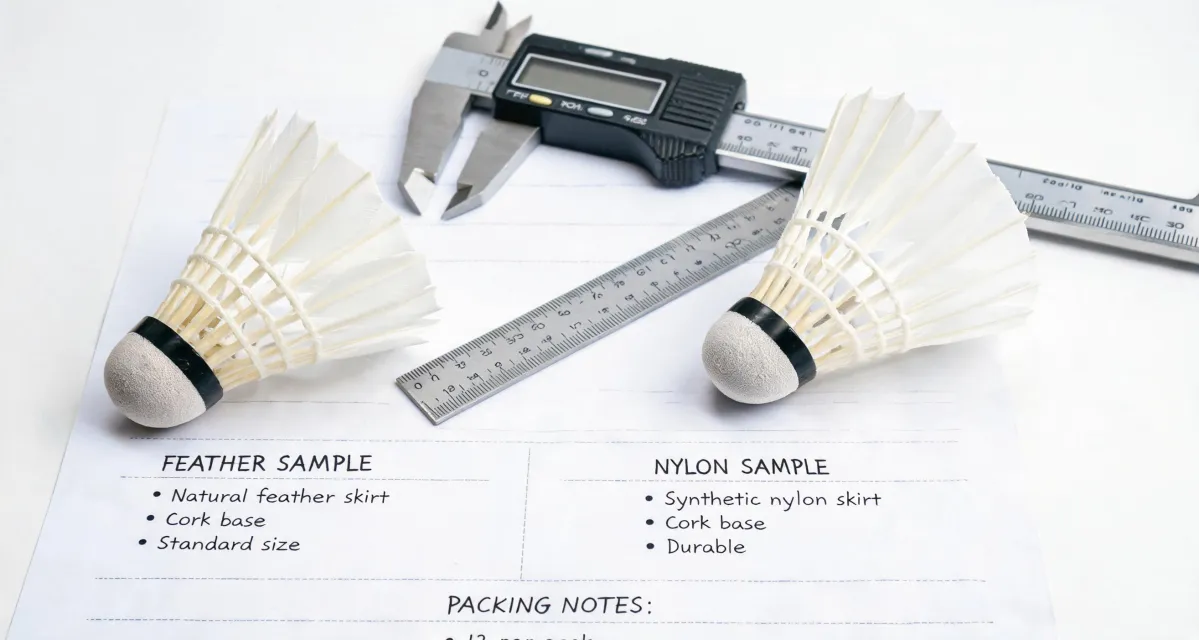
Two of the three speed bands published for YONEX MAVIS 350 overlap. Green cap is listed as Slow for 22–33°C and blue cap as Medium for 12–23°C, so the same tube in a 22°C hall satisfies both labels. A cap color, in short, does not resolve to one band, and a wholesale sample sheet that records only the cap color records nothing a second batch can be measured against.
The mechanism sits on the same page: the hardness of the skirt, the feather part of the nylon shuttlecock, varies with temperature. Scope before anything else — this is the YONEX MAVIS 350 and MAVIS 2000 page, a manufacturer's published key, not an independent test run by this desk, and not a rule for feather shuttles or another factory's nylon mould. What it hands a US sourcing team is a recording habit: judge the bird at the temperature it was played in, and put that number on paper next to the verdict.
Your Sample Verdict Depends on Room Temperature
Same tube, two halls, two verdicts. A skirt that stiffens in cold air and softens in warm air flies differently in each, which is why speed is keyed to a temperature band rather than to a fixed grade stamped on the cap. The identical tube hit in a cold hall in January and in a warm one in July is two different products in flight.
The file breaks at the seams. Blue and red also overlap at 12–13°C, so a hall sitting anywhere between 12 and 13°C is inside two legitimate bands at once. Write medium on the sheet and the next reader has two defensible readings and no way to choose; write nothing and they have none.
A buyer who pastes these ranges into a generic OEM specification has written a requirement no supplier has agreed to. Copy the reasoning instead: temperature first, flight verdict second.
Write Down Four Fields on Day One
On day one, before the first tube is opened, the sheet needs four entries. Put the date down. Put the room temperature in Celsius at the moment of play down, read from a thermometer in the hall rather than from a weather app. Put the model and cap label down exactly as printed on the tube, with the pack count the page gives for that model — one tube of six shuttlecocks — because pack count is how the factory and your receiving dock reconcile the shipment. Then a short flight note: how it flew, how it finished, and who hit it.
The effect is comparability, and it is not subtle. Two batches from one factory, or one batch from two factories, become readable against each other only when the degree reading sits beside the verdict. Filed under memory, felt slow means nothing six weeks later. Filed under a degree reading with a date, it means something a QC lead can act on.
Write the degrees down first, then argue about how the bird flew. The cap color goes in its own box, because the color is a label somebody prints and the temperature is the thing you can check afterwards. By the end of the first week, two people on the team should be able to read the same sheet and agree on what happened on the floor.
The Yellow Slow Label You Must Not Fix
The tube labeled M350YF carries Yellow/Slow on the page, while the F in its own code points the other way — the page's fast band belongs to the red cap. The two readings disagree, and nothing on the page resolves which one is right.
Quote it as printed. A buyer who silently rewrites that label to Fast has created a specification that matches no document and no carton; when the shipment lands with Yellow/Slow caps, the corrected sheet is the thing that loses the argument. Leave the oddity visible and let the supplier explain it.
Ask in writing: which speed label does your equivalent product carry, and for which temperature band is it intended? Add the color question while you are there, since the page lists White and Yellow for this model and an OEM run may not offer both. The answers go in the file before anything is copied onto your own spec sheet, because a label you cannot trace is a label you cannot enforce at receiving.
Treat Four Times Durability as a Claim
The MAVIS series is described as flying close to feather and lasting four to five times longer than an ordinary nylon shuttlecock, which the maker frames as cost-effective for practice sessions. Read the sentence for what it is: a manufacturer comparing its own series with a generic nylon bird in practice play. Nobody on your side hit anything.
Put that figure in your comparison table and it starts behaving like measured data, outranking the readings your own team took. Four to five times is also not a stable quantity. It depends on the ordinary nylon it was measured against, on how the session was run and on the temperature of the hall, and those conditions are not published with the number.
Convert it into procurement questions. What is your batch durability test method — hand hitting or machine — how many tubes per batch, how many hitters, at what room temperature, and what result counts as a fail? Factories answer these very differently, and the shape of the answer tells you more about the batch than any multiplier does.
Run the Same Tube at Two Temperatures
Suppose your QC lead takes one tube and hits it twice: once in a hall near 12°C and once near 28°C, both figures inside the published bands. Write the pass and fail condition before the first hit — how many rallies, what drop-off counts as short — otherwise the second session gets graded against a standard invented on the spot.
Two readings separate two causes that a single reading fuses. If the tube flies short at 12°C and fine at 28°C, the temperature band is talking, and the fix is a different cap grade rather than a different factory. If it flies short in both halls, the batch is the problem and the conversation changes completely.
No results are claimed here; this is a plan you run on your own samples in your own halls. Three months later, the two-temperature record is the only artifact that lets you compare a February delivery with a June one, and it costs one extra reading rather than a second shipment.
Stop the Purchase Order When the Record Is Thin
By the end of the first month you should hold quotes, sample notes and written supplier answers. If the file is still missing a dated temperature reading, a printed cap label confirmed in writing, a quote, an MOQ, a lead time, a capacity statement and written customization rights, it is not ready for a purchase order. Not thin. Not almost. Not ready.
Those are this team's sourcing judgments, not findings about any factory's performance, and they sit apart from what the reference page actually documents: speed bands, cap colors and pack count for two models. The page says nothing about price, volume, capacity or who may put a logo on a tube, and it cannot fill any of those gaps for you.
No reading, no signature — that is the whole rule, and it holds whether the sample came from a trading company or from a plant. Purchasing pressure is the usual reason a thin file gets approved; the signature rule exists because that pressure is normal, not exceptional.
Today's job is one line on the form your QC team already uses: room temperature in Celsius at the moment of play, filled in before anyone signs a verdict. Until that line exists, every verdict in the file is an argument.

Leave a procurement question