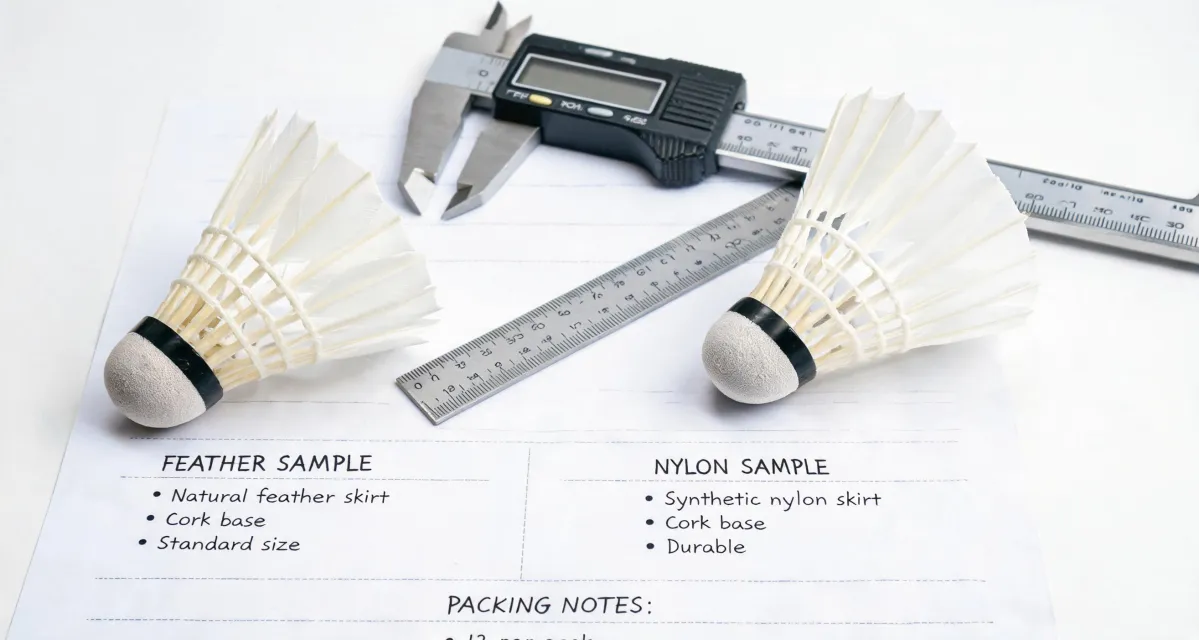
The mistake shows up on nearly every first pass at a shuttlecock wholesale order: the buyer opens a tube, counts six shuttles, reads the color and speed print, and files the lot as checked. Pack format is not provenance, and provenance here means the documented chain from a reliable retailer to your dock. A tube that matches the model page on count and label can still sit on a lot with no confirmable purchase history behind it, and that gap is where the money goes missing.
For this scope, which is YONEX MAVIS 350 and MAVIS 2000 shuttlecocks as described on the manufacturer's model page and its counterfeit-warning page, documented purchase history should outrank printed pack appearance when you select or exclude a supplier. The pack check still earns its place, since it is the cheapest filter available and it runs before any price talk, but it answers a different question than the one that decides whether a lot is supportable.
Start With a Single-Tube Spec Check
The model page sets fields you can verify without any supplier cooperation, and they are worth fixing in your intake form before a single quotation arrives. Quantity is one tube of six shuttlecocks. The colors listed are White and Yellow. Speeds are Slow, Medium and Fast, and each speed grade, meaning the tube's rated playing-temperature class, is tied to a cap color and a Celsius band: green cap for Slow at 22 to 33 Celsius, blue cap for Medium at 12 to 23 Celsius, red cap for Fast at 0 to 13 Celsius. That key explains why the color field and the speed grade belong in separate columns instead of one free-text note.
Record model, tube count, color, speed grade, cap color and the matching band as six distinct fields. Boundaries matter here. A model page describes a model, not a shipping case; it says nothing about how many tubes come in a wholesale carton, so any case count a supplier quotes stays an unverified commercial claim until it appears in writing. One loose end belongs on the clarification list from day one: the page labels SKU M350YF as Yellow/Slow, a pairing that does not line up with the F sitting in the same code. Do not quietly rewrite that as Fast. Photograph the label and ask the supplier to explain the discrepancy in writing.
Why Tube Appearance Cannot Prove Provenance
The manufacturer's counterfeit page draws a line that most sourcing checklists miss. It recommends buying from a reliable retailer so the product can be used with peace of mind, then states that after-sales service, quality assurance and compensation for damages do not apply to products purchased through private sales, including counterfeit products, or to products whose purchase history cannot be confirmed. That last category is defined on the page through the missing document: products that do not come with a warranty card clearly stating the retailer.
Notice what the page does and does not hand you. It gives a channel test and a history test; it gives no print-inspection or hologram test, and never claims a visual check substitutes for either. The obvious objection is that a sharp photo of the tube, with the correct count, cap color and print, settles the matter. Here's the catch: a photo proves pack appearance and nothing more. It cannot show which retailer the tube passed through, and the untraceable channel is exactly the category the manufacturer excludes. The photo's real job is narrow, telling you whether the item is worth investigating at all.
Screen Wholesale Channels in This Order
Rank channels in three passes, and do not let a later pass pull rank on the first. Pass one: is this a reliable retailer, or a private sale you cannot trace? Pass two: can the seller produce a purchase history and a warranty card naming the retailer for the specific lot on offer? Pass three: only now compare commercial terms such as price, packing format and delivery schedule.
The candidate you want is a documented retail channel. The one you exclude from support-bearing procurement is a private-sale or history-less channel, however attractive the quote. A skeptic would say the private-sale lot is cheaper and the paperwork is administrative overhead. That reading collapses the moment you follow the manufacturer's sentence to its end: missing history is not a filing inconvenience but a support exclusion the buyer absorbs and then passes down to the club or team that eventually plays with the shuttles. Cheap tubes without a traceable chain are not a discount on the same product; they are a different risk category.
Build a Pack-and-History Record Set
Retain one record set per order, not per supplier. The set holds the exact model name; the per-tube count of six; the listed shuttle color; speed grade with cap color and temperature band; a photo of the SKU label including the Yellow/Slow wording as printed; the retailer invoice; the warranty card naming that retailer; and the purchase-history confirmation for the lot. Tie every document to the exact model rather than to shuttlecocks in general, because a detail read off the MAVIS 350 page does not transfer to another model, another factory or a private-label build.
Be clear about what the set can and cannot do. This set is a retention checklist, not a proof of authenticity, and nothing in it converts a photo into provenance. Items the model page never covers, such as quoted MOQ, lead time, production capacity, customization rights and sample-test results, stay open procurement questions. They are not fields you can fill by inference from a reference product, and writing a plausible number into one of them is worse than leaving it blank and asking.
What to Ask Before Approving a Sample
Put the questions in writing and require written answers before approval. Ask the supplier to explain the M350YF Yellow/Slow label against the F in the same code. Request written confirmation of count, color and speed grade against the model page for the exact model being offered, not against the product family. Require the retailer and purchase-history documents covering the offered lot. Then ask which of the supplier's numbers, whether MOQ, lead time, capacity, customization rights or sample-test claims, are commitments and which are estimates.
Suppose a supplier answers the pack questions cleanly and the provenance questions not at all. That sample then serves one purpose: pack-format reference. That sample is not an approved wholesale source. The same holds for a supplier's own shuttle test, which is the seller's claim about its own goods, not an independent result you can carry into a customer conversation. If the item offered is another brand or an OEM tube, the reliable-retailer standard belongs to whoever owns that brand; ask that party to state it in writing instead of assuming the MAVIS wording covers a product it was never written about.
The objection that usually arrives last is whether an unverifiable sample is still worth having. Such a sample retains value, within limits. Use it to confirm pack format, meaning the count, the cap colors and the label layout, and to generate sharper written questions, then keep it in a reference-only folder and out of the approved folder until reliable-retailer and purchase-history records exist for the lot it represents. A sample that cannot be traced still tells you what the packaging looks like; it just never tells you what happens when a tube fails.

Leave a procurement question