-
A speed grade is a temperature class
-
Why 'tournament grade' cannot replace a cap color
-
A wrong cap color costs more than the price gap
-
Four questions that settle the cap color before you quote
-
From a hall thermometer to a locked purchase order
-
Where green, blue and red bands overlap
-
What you give up narrowing to two cap colors
A wholesale shuttlecock order is a temperature decision before it is a price decision. On the YONEX MAVIS 350 and MAVIS 2000 line the grade is printed on the cap: green cap is Slow for 22-33°C, blue cap is Medium for 12-23°C, red cap is Fast for 0-13°C. Those bands overlap at the edges, so a label alone will not settle a shipment going into a mixed-climate territory. Every number here belongs to that model line and the manufacturer's product page; other models, OEM builds and your own private label need their own bands confirmed in writing.
The first quote request from a new buyer usually asks for the strongest-sounding grade and assumes it covers a whole season. On this line the grade is a printed temperature band, so a red tube sent to a warm hall is a wrong spec rather than a better shuttle.
A speed grade is a temperature class
Read the cap before you read the model name. A speed grade here is a labeled temperature band attached to a cap color, and the manufacturer states that the hardness of the skirt, the feather part of the nylon shuttlecock, varies depending on temperature. The graded property is physical, and it exists to compensate for the hall rather than to rank the product. Model number tells you the family, cap color tells you the band you are committing to. Both belong on the purchase order, but only one of them can be checked against the temperature your players actually play in. Two buyers can order the same model and end up with shuttles that behave differently in the same gym, purely because one took green and the other took red.
Why 'tournament grade' cannot replace a cap color
Words like tournament grade, premium and club level carry no band. Nothing in them says what temperature the shuttle was built for, so you cannot check them against a hall reading or reject a shipment against them. The cap color can be checked: it either matches the band you specified or it does not, and that verdict takes one look at the inner-box label.
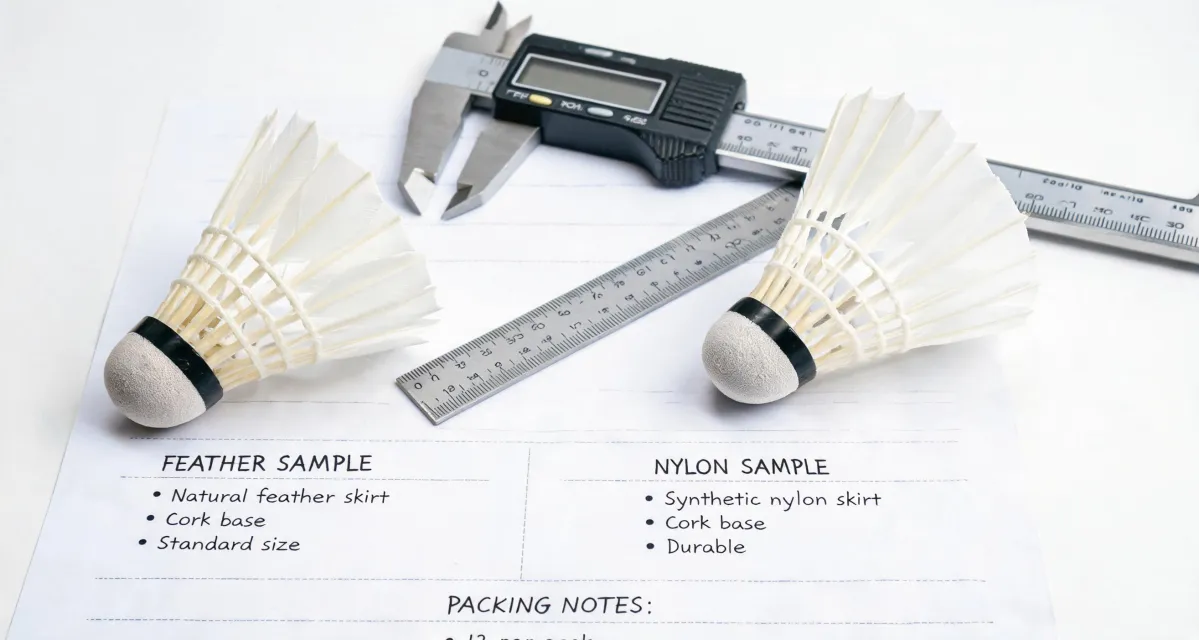
On the same page, the spec table sits three different things side by side: Speeds Slow, Medium, Fast, plus Colors White and Yellow, plus a pack of 1 Tube / 6 Shuttlecocks. Read those as three separate lines of a specification. Tube count and inner pack are packing terms. Shuttle color is a color option, and it does not change which band the cap declares. Only the speed word speaks to performance, and it means nothing when it is quoted without the cap color and the band beside it. Meeting the tube count and the shuttle color does not meet the band.
A wrong cap color costs more than the price gap
Receiving inspection will not catch it. Carton count is right, the tubes hold six, the shuttles are the color you ordered, the label prints a speed word. The error surfaces in play, when the shuttle sails long in a warm hall or dies short in a cold one, and by then the stock is yours. Suppose a school district warehouse takes one grade for a dozen gyms, nine running warm and three in an old building that stays cold all winter. The three cold courts generate the complaints, the warehouse re-sorts and re-ships, and the coach who placed the order stops trusting the SKU. The price gap between two grades is one line on an invoice. A grade that does not fit the hall keeps costing you until the last tube is gone.
Four questions that settle the cap color before you quote
Ask them in this order and each answer narrows the next. What temperature will these shuttles actually be played at, and at what time of day? The hall at 8 a.m. in January is not the hall at 7 p.m. in July, and an annual average hides exactly the hours that produce complaints.
If the honest answer is a seasonal range rather than one number, which band gets the bulk of the order? That range tells you that you have a split, not that three colors deserve equal depth. Who owns that number, the club that plays, the distributor that resells, or the warehouse that stores it? Whoever owns it is the party you ask to sign off the band, because they are the one who fields the complaint in February.
And if the spec sheet's cap color and the SKU suffix disagree, which one goes on the purchase order? That question is not hypothetical. On the page for this line, the SKU reads M350YF Yellow/Slow even though the suffix says F, and the inconsistency has not been explained. Do not quietly rewrite it as Fast in your own paperwork. Put the question to the supplier and get the answer in writing before the PO is issued.
From a hall thermometer to a locked purchase order
Log the actual playing temperature per hall and per season, not the outdoor forecast and not the thermostat in the front office. Convert each logged band to a cap color on the printed scale. Split the order across bands only where logged hours genuinely straddle two of them; a split you cannot defend from the log is stock you will re-sort later. Write cap color, speed word and SKU together on the PO, because any one of the three alone can be satisfied by the wrong tube. Approve a pre-production sample against the named band and keep that approved sample. That is a sample-approval step, not a laboratory test, and it does not prove how the shuttle will fly in your gym. On the first bulk arrival, check inner-box cap color and printed speed before releasing the balance.
What this plan cannot do is price the order. No supplier quote, MOQ, lead time, capacity figure, customization right or physical sample result sits behind these steps, so all of them stay as questions you put to the supplier before you commit.
Where green, blue and red bands overlap
These bands share edges. Green Slow 22-33°C and blue Medium 12-23°C both cover 22-23°C. Blue 12-23°C and red 0-13°C both cover 12-13°C. Leave the overlap as printed; rounding it into clean cut-offs invents a rule the label does not contain.
Inside an overlap the cap color cannot be the tiebreaker, so the decision has to be made locally and written down before the PO, or the same hall gets two answers on two orders. Three short illustrations, all hypothetical. Imagine a warm upstairs court that sits at 26-28°C through summer: it falls inside green alone. Imagine a basement hall dropping to 15-16°C in winter: it falls inside blue alone. Imagine a converted rink at 8-10°C: it falls inside red alone. Now imagine a hall that measures 22-23°C in spring, where green and blue both claim it: the defensible answer is the one you fixed in advance, the lower band for a cold, draughty space and the higher band for a warm, still one, recorded beside the temperature log so the next buyer repeats it instead of re-arguing it.
What you give up narrowing to two cap colors
If your logged hours sit in two bands and you can restock by season, I would narrow the order to two cap colors and buy depth in each. Fewer SKUs, one label check on arrival, reorders that move because nobody is hunting for a third carton. What you give up is the ability to pull an unusually cold or unusually warm hall out of stock, and a temperature swing catches you until the next shipment lands. That preference fails in two common cases: distributing across climates, or supplying a portfolio of venues that runs from a heated club to an unheated barn. There you need all three colors on the shelf, because thinning them is how red gets shipped to a warm court simply because it is what remains.
There is no version of this where you get both full coverage of every hall and lean, fast-moving stock. The side you pick is a bet on how stable your temperatures are, and the cheaper bet is the one your log actually supports.

Leave a procurement question